


Hazardous Goods- Transport Clean-Up Insurance Explained
Why Hazardous‑Goods Transporters Must Take Environmental Risk Seriously
Transporting hazardous goods — whether industrial chemicals, corrosives, flammables or other potential pollutants — carries inherent environmental risks. In South Africa, legislation such as the National Environmental Management Act (NEMA) requires strict compliance when dangerous substances are involved. If a hazardous substance is released into the environment — for instance by a spill from a tanker — that release must be reported under NEMA. This reflects the law’s recognition that such substances can cause “significant harm to the environment, human life or property” — even if actual damage has not yet occurred. For transport companies, non‑compliance is not just a legal risk — it’s a very real financial, reputational, and operational risk. That’s why having the right environmental insurance and clean‑up cover is just as important as safe driving and proper loading procedures.
What Can Go Wrong — A Recent Example
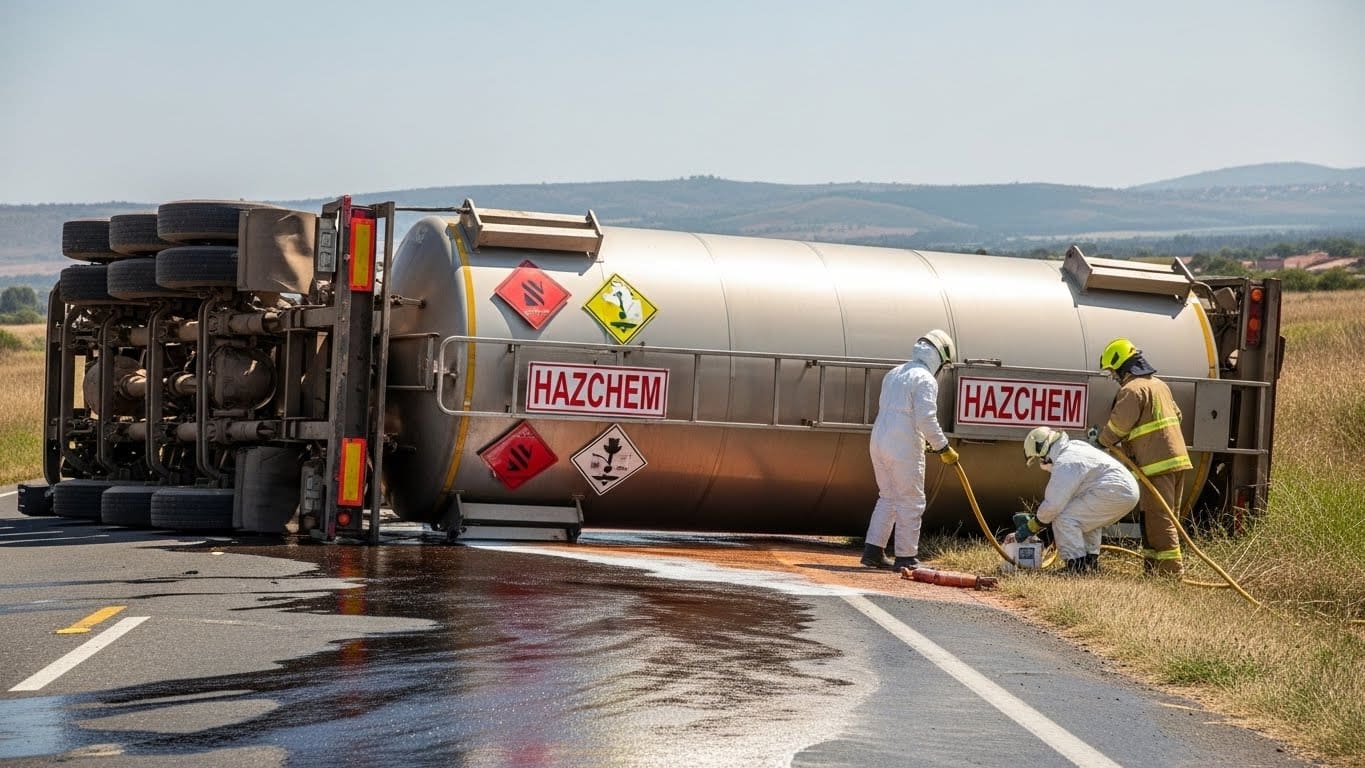
A stark reminder of the risks occurred recently on the R521 road near Polokwane. On 28 July 2025 a tanker truck — reportedly carrying a hazardous chemical (hydrochloric acid) — collided with a light delivery vehicle and overturned.
The result: a major chemical spill, road closure, environmental hazard, and a multi‑agency response. Emergency services, including environmental health teams and hazmat spill units, were called in to neutralise the chemical, contain the spillage and clean up — soil and road surfaces had to be treated to prevent contamination.
The road remained closed while clean-up was underway, affecting traffic and commerce — particularly transport-dependent industries in Limpopo. Although there have been no public reports of fatalities, the potential for serious environmental damage — harm to soil, water sources, air quality, flora/fauna — was very real.
This case underscores how quickly a transport accident involving hazardous chemicals can escalate into an environmental disaster — with major financial and regulatory consequences — even before any “worst-case” outcomes (fires, explosions, mass casualties) occur.
What Transport‑Clean Up Cover Offers — How It Protects You
Transport‑clean up covers designed for hazardous-goods transport go beyond standard goods‑in‑transit or cargo insurance. A good policy, such as that offered by partner insurer Envirosure (with whom we at Osure Brokers collaborate), provides protection tailored specifically for environmental incidents.
Typical features of such a policy include:
- Spill containment and environmental restoration — including emergency response, clean-up, neutralisation of chemicals, and rehabilitation of affected soil, water, or roadside areas.
- Coverage for both first- and third‑party clean-up costs — whether the spill impacts your own vehicle/load, or causes damage to third‑party property or environment.
- Risk management and compliance support — including spill‑kits, training, 24/7 emergency‑response support, and assistance with environmental‑incident reporting and regulatory compliance (per NEMA).
- Customisation to match the scale and type of transport — from small LDVs carrying industrial chemicals to large tanker trucks transporting bulk hazardous cargo; including cover for side‑tank spills, loading/unloading incidents, contractor‑subcontractor transport operations, and more.
When you consider how many things can go wrong on South African roads — from collisions to overturning to loading accidents — having a solid environmental‑clean up policy is not optional. It’s critical for compliance, protection and business continuity.
How Legislation Shapes What You Need
Under NEMA — and related environmental regulations — any release of a hazardous substance that qualifies as a “reportable quantity” must be reported.
Furthermore, the environment is broadly defined: damage (or potential damage) to soil, water, flora, fauna or even atmospheric release are all covered.
For transporters, this means that even a seemingly minor spill — a drum falling over during loading, a leak during transit, or an accidental leak from a side tank — could trigger reporting obligations and potential liabilities.
Having transport‑clean up cover ensures you are not only compliant but also protected financially in the event of a spill or release.
Why Osure Brokers Is the Right Partner
At Osure Brokers, we understand the unique risks faced by companies transporting hazardous goods or other potentially polluting materials. That’s why we’ve partnered with Envirosure to offer an enhanced Transport Clean-Up Policy — tailored for South Africa’s regulatory environment and real-world road‑transport risks.
With this policy, our clients benefit from:
- Access to a full 24/7 emergency‑response call center for spill incidents
- Immediate mobilisation of specialised clean-up teams
- Cover for both vehicle‑related and cargo‑related spill events
- Customisable cover levels for small to large transport operations
- Support with environmental‑incident reporting and NEMA compliance.
Final Thoughts
Transporting hazardous materials carries risk. Sometimes, despite the best precautions, accidents happen. And when they do — road collisions, overturns, leaks — the cost is not just to your load or your truck: it’s to the environment, third‑party property, public safety, your compliance record, and your bottom line. For any business that handles hazardous goods — from industrial chemicals to corrosives to flammables — having the right transport‑clean up cover is not a “nice to have.” It’s essential. If you’re transporting hazardous or potentially polluting materials, get in touch with Osure Brokers today to discuss your risk profile and how Transport Clean-Up Cover can safeguard your operations, compliance, and reputation.